Flat Washers Vs. Spring Washers: Differences, Applications And Selection Guide
Nov 02, 2026
Washers are essential components in industrial fastening systems. Although they are relatively small, they play an important role in load distribution, surface protection, and assembly performance.
Among the commonly used types, Flat Washers and Spring Washers serve different purposes in mechanical and industrial applications. Understanding their structural differences and working characteristics helps manufacturers, distributors, and industrial buyers select suitable fastening components for their projects.
In this article, we will explore the functions, applications, material options, and purchasing considerations of these two common washer types.
For more product information, visit our Washers category.
1. Flat Washers: Functions and Industrial Applications
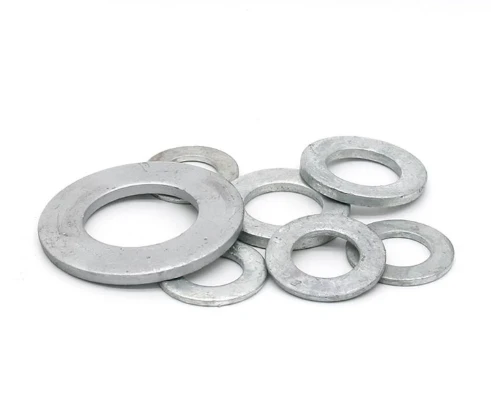
A Flat Washer is a thin, flat metal disc with a hole in the center. It is commonly installed between a bolt head or nut and the connected surface.
Its primary function is to distribute the clamping load over a larger contact area, helping reduce localized pressure and protect the surfaces of connected components.
Key Advantages of Flat Washers
Load Distribution: Spreads fastening pressure across a wider bearing surface.
Surface Protection: Helps reduce direct friction and potential damage between fastening components and connected materials.
Assembly Stability: Provides a more uniform contact surface for bolted connections.
Dimensional Compatibility: Available in different dimensions to match various bolt sizes and assembly requirements.
Common Applications
Flat washers are widely used in industrial machinery, automotive components, steel structures, electrical equipment, and general mechanical assemblies.
When selecting flat washers, buyers should consider inner diameter, outer diameter, thickness, material, and applicable manufacturing standards.
Explore our Flat Washer products for more information about available specifications and product options.
2. Spring Washers: Structure and Working Principles

A Spring Washer is designed with an elastic or spring-shaped structure. One commonly used type is the split lock washer, which features a split and slightly raised ends.
When compressed during installation, the washer undergoes elastic deformation and generates a reaction force.
Main Characteristics of Spring Washers
Elastic Deformation: Its structure allows deformation under compression within its intended working range.
Spring Reaction: Generates a reaction force when compressed as part of a fastening assembly.
Compact Structure: Provides a spring-type component in a relatively small installation space.
Application Flexibility: Can be selected for specific fastening requirements based on operating conditions and engineering specifications.
Common Applications
Spring washers are used in selected mechanical equipment assemblies, industrial machinery, electrical equipment, and general fastening systems.
However, conventional split spring washers should not be regarded as a universal solution for preventing loosening under severe vibration. For demanding applications, the entire fastening system and appropriate locking methods should be evaluated.
Explore our Spring Washer products to learn more about product specifications and available options.
3. Flat Washer vs. Spring Washer: What Are the Differences?
Although both products are used in fastening assemblies, their structures and intended functions are different.
| Comparison | Flat Washer | Spring Washer |
|---|---|---|
| Structure | Flat circular disc | Split spring-shaped structure |
| Main Function | Distributes bearing load | Provides spring reaction |
| Contact Surface | Flat bearing surface | Raised or split structure |
| Typical Application | Surface protection and load distribution | Selected spring-type fastening assemblies |
| Selection Factors | Diameter, thickness, material | Spring characteristics, dimensions, material |
How to Choose the Right Washer?
Choose a flat washer when the primary requirement is to distribute fastening loads, protect contact surfaces, or provide a suitable bearing area.
Consider a spring washer when the fastening design specifically requires an elastic component and its performance is suitable for the intended operating conditions.
For high-vibration or safety-critical applications, engineers should evaluate bolt preload, joint design, and appropriate locking solutions instead of relying on washer type alone.
4. Common Materials and Surface Treatments for Industrial Washers
Material selection directly affects the mechanical properties, corrosion resistance, and service performance of industrial washers.
Carbon Steel
Carbon steel washers are widely used in general industrial fastening applications. The appropriate material grade and surface treatment should be selected according to project requirements.
Stainless Steel
Stainless steel washers are suitable for applications where corrosion resistance is important, including outdoor equipment and environments exposed to moisture.
Alloy Steel
Alloy steel may be considered for applications requiring specific mechanical properties and performance specifications.
Surface Treatment Options
Depending on the working environment, zinc plating and other protective coatings may be considered to improve corrosion protection.
Before purchasing, buyers should confirm material grades, coating specifications, dimensional tolerances, and applicable manufacturing standards.

5. What Should Buyers Consider When Purchasing Washers?
For overseas distributors, wholesalers, and industrial manufacturers, selecting a reliable washer supplier involves more than comparing unit prices.
Here are five important purchasing considerations:
1. Product Dimensions
Confirm the inner diameter, outer diameter, thickness, and dimensional tolerances according to your assembly requirements.
2. Manufacturing Standards
Specify the required DIN, ISO, ASTM, ANSI, or other applicable standards.
3. Material Requirements
Choose suitable materials based on mechanical performance and working environments.
4. Quality Inspection
Pay attention to dimensional accuracy, material verification, production consistency, and quality control procedures.
5. Customization and Supply Capacity
For OEM projects and non-standard applications, confirm whether the manufacturer can evaluate technical drawings and provide customized manufacturing solutions.
Providing complete specifications helps manufacturers understand your requirements and prepare more accurate quotations.
6. Why Choose Jiaxing Jinling Hardware?
Jiaxing Jinling Hardware Technology Joint Stock Co., Ltd. is an industrial fastener manufacturer established in 2005.
With manufacturing experience, production capabilities, and technical support, the company serves international customers with different industrial fastening requirements.
Key advantages include:
Manufacturing Experience: Established in 2005, with experience in the fastener industry.
Production Capacity: Manufacturing capacity to support bulk purchasing requirements.
International Standards: Products covering various international standards, including ISO, DIN, ANSI, ASTM, and JIS, depending on product specifications.
Customized Manufacturing: Technical evaluation and manufacturing support according to customer drawings and requirements.
Quality Management: Production inspection and quality control support for industrial fastener requirements.
Whether you are sourcing flat washers for machinery manufacturing or spring washers for specific fastening applications, choosing a suitable manufacturing partner is important for maintaining product consistency and supply reliability.
7. Frequently Asked Questions
Q1: What is the main difference between flat washers and spring washers?
Flat washers mainly distribute bearing loads and protect contact surfaces, while spring washers feature an elastic structure designed to generate a spring reaction under compression.
Q2: Can flat washers and spring washers be used together?
They may be used together in certain fastening designs, depending on assembly specifications and engineering requirements.
Q3: Which washer is suitable for industrial machinery?
The correct choice depends on the application. Flat washers are commonly used for load distribution and surface protection, while spring washers are used in selected assemblies requiring a spring-type component.
Q4: Can washers be customized according to customer drawings?
Customization may be available depending on product dimensions, materials, manufacturing standards, and production requirements. Buyers can submit technical drawings for evaluation.
Q5: What information is required for a washer quotation?
Buyers should provide the washer type, dimensions, material, surface treatment, applicable standards, order quantity, and technical drawings if available.
8. Contact Jiaxing Jinling Hardware for Your Washer Requirements
Are you looking for a reliable supplier of flat washers or spring washers?
Jiaxing Jinling Hardware Technology Joint Stock Co., Ltd. welcomes inquiries from overseas distributors, wholesalers, machinery manufacturers, and industrial buyers.
Send us your technical drawings, product specifications, or purchasing requirements. Our team can help evaluate your needs and discuss suitable manufacturing solutions.
Get in touch with Jiaxing Jinling Hardware Technology Joint Stock Co., Ltd. for product inquiries, technical support, and customized manufacturing solutions. We look forward to discussing your requirements and building a long-term business partnership with you.
Our address
No.32, Shenjiadai, Xuyouche Village, Qinshan Subdistrict, Haiyan County, Zhejiang Province, China
Phone Number
+8615957319518
jlzxl@jinlingfstn.com